What’s the Best Way to Prevent Weeds When You Start Spring Gardening?
Spring is Coming! Great News! Your Spring Flowers & bulbs are starting to pop through the soil. However, if you have a garden in pots or planted in the ground you may also be asking yourself, “Now how do I get rid of all these weeds sprouting up too?!”
Did you know there are hundreds of different types of weeds that grow here in Albuquerque? But don’t worry, all you need to know is that there are only three weed categories that you need to be familiar with when identifying weeds (and then killing them!). Below are quick descriptions to help you determine which category your weed belongs in:
- Broadleaf: Leaves are wide with veins that branch out in different directions.
- Grasses: Leaves are narrow, arranged in set of two flattened or rounded stems.
- Sedges: Leaves are narrow and arranged in sets of three; stems are triangular in cross-section.
While identifying which weed you have may be important to figuring out how to chemically treat them; you may not have the time or desire to Google every weed you don’t know. That is why in this article we will break down a few general tips to help you kill and prevent most garden weeds that come up in the spring season.
Manual vs. Chemical Weed Control
There are two ways to control weeds:
- Pulling them out by hand, or with a tool
- Chemical weed control
Pulling weeds out by hand
Pulling weeds out by hand can be easy and effective for home gardeners. Especially when you pull the weeds out whole with the roots. Tools like hoes work well for weeds with short roots near the surface of the soil. Hand weeding tools are great for grabbing weeds with longer roots and pulling them out of the soil.
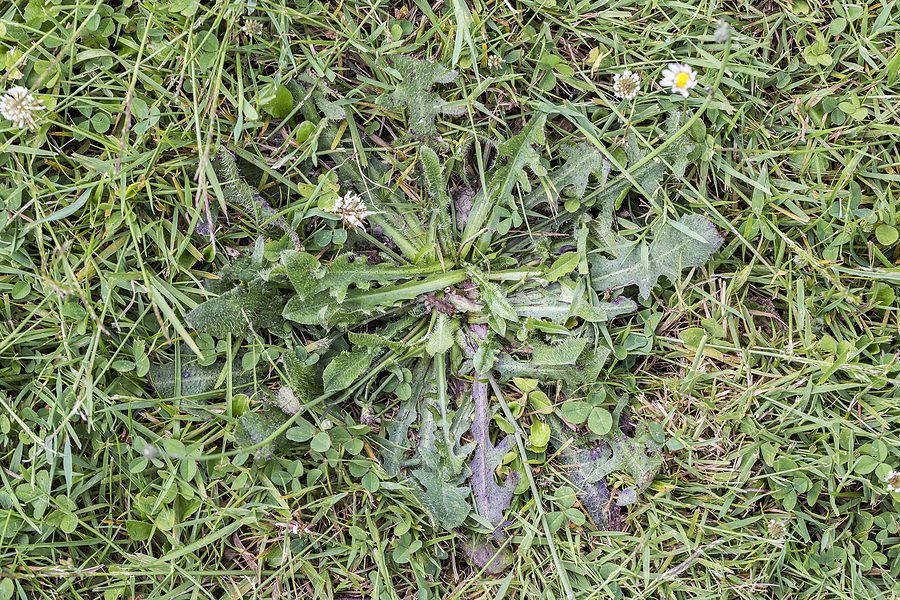
Tip: Remove the whole root. Some perennial weeds like dandelions grow long roots known as a taproot. Make sure you pull up all the root, or that weed will just continue to grow back. Ideally you want to pull weeds when the soil is damp. Damp soil will allow the roots to easily come out of the soil. If the soil is dry or very packed, using a hand tool that can grab onto the root will help lift it out of the ground.
Chemical weed control
Commercial herbicides can be used to treat large areas with serious weed problems. But did you know that chemicals found in many herbicides can also harm bees & pollinators? Most herbicides also kill beneficial insects that help control pest populations. At R & S Landscaping we recommend limiting herbicide use as much as possible and practicing organic gardening methods. Herbicides are rarely needed in home gardens where hand weeding can usually control weeds.
Best Time to Pull Weeds
The best time to pull weeds is early and when they’re tiny. Pulling weeds early prevents them from going to seed, which means they will not be spreading seeds around your yard to grow more weeds! Tiny weeds are easier to pull too. Another great time to pull weeds is when they become mature; you’ll just have to be sure to get all of the roots. Larger weeds may have deeper roots that require you to dig down into the soil to remove the entire root. Always wear gloves when pulling weeds. Some weeds have prickly leaves or sap that can irritate your skin.
Preventing Future Weeds
You may have seen labels at your local garden store that say “Pre-emergent.” These are chemicals that you apply to your soil to prevent weeds from growing. But did you know that mulching is one of the best ways to prevent weeds?
Mulch is any material that is applied to the top of your soil. Mulches can be organic or inorganic; both have their benefits when preventing weeds.
Inorganic mulches include rocks, gravel, or landscaping fabric. In order for weeds to not be able to grow through inorganic mulches; you need to stop sunlight from reaching your soil. Rocks and gravel are porous – unless they’re really small – so you’ll want to apply these materials 3-5 inches thick. For maximum weed prevention, lay down a layer of landscaping fabric before applying your rocks/gravel. This prevents ANY sunlight from getting through.
Organic mulches include wood chips, straw, and seed hulls. Like inorganic mulches, these materials also prevent weeds by blocking the sun’s rays from reaching the soil. Organic mulches have a bonus benefit of retaining moisture in your soil and helping improve your soil’s overall structure. Apply 2-3 inches of small sized mulch (example: small diameter wood chips) to prevent weeds. Larger wood chips and materials should be applied 5-6 inches thick. Just like with inorganic mulches, you can lay down landscaping fabric first to ensure no sunlight reaches the soil.
No matter what type of mulch you use, be sure to wait until you have pulled all weeds from the soil THEN apply your mulch. Mulch prevents sunlight from reaching your soil, so if you apply it before you weed; you won’t be able to see the weed seeds germinating. Not seeing weeds pop p doesn’t mean they aren’t there.
After mulching your space (and weeding beforehand) all you may need to do to control future weeds is occasional hand weeding and spraying of weed offenders. Every year you will have less weeds as you have removed the ability for them to produce seeds or underground bulbs. It will take a couple of seasons of manual weeding and replenishing your mulch, but you will have an almost weed free garden!