What are the Most Common Lawn Problems Homeowners Face and How Do You Fix Them?
Right now your grass should be coming in thick and green and healthy.
You’re frustrated by the results of your lawn care efforts because of things like:
- Dead patches
- Wet, squishy patches
- Weeds
You’re not alone. It’s something we hear about all the time at R & S Landscaping from homeowners like you.
So, what’s causing it? Why does your lawn look straggly while your neighbor’s grass looks stunning?
Dead Patches
It’s annoying (and ugly) when your lawn is pocked with brown, yellow, and bald sports all over the place.
Here’s why that happens:
- Heavy compacted soil: If you don’t get out there and aerate properly.
- Poor quality of soil: Simply put, soil is “alive”—it’s full of healthy nutrients and organic matter. When soil “dies”, it becomes dirt; which is of no benefit to grass.
- Animal urine: Dog and other animal urine on your lawn leaves dead spots. The tell-tale sign is yellow patches ringed with a bright green edge.
- Last years drought damage: Your lawn should receive 1” of water/week, if it doesn’t, between that and regular weak spots (or in a very sunny area), it suffers.
- Last year’s insect damage.
The remedy isn’t terribly difficult:
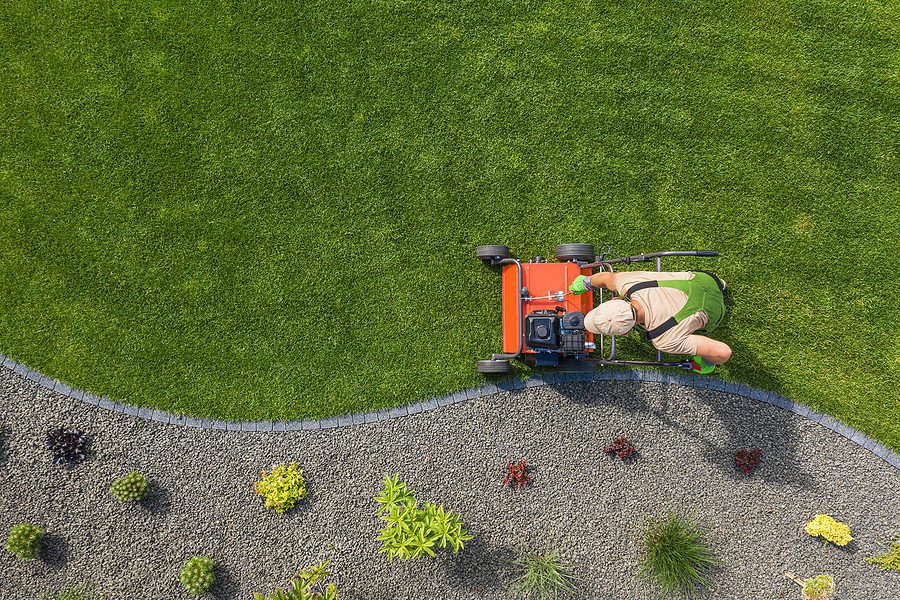
If you’ve left the mower blades dull, for instance, get them sharpened. Or if you haven’t aerated the lawn in years, let us take care of that for you. Dead patches can be repaired through aerating and topdressing and full death by seeding. Watch this video to see how.
Flooding, Ponding, or Pooling
Poor backyard drainage (it’s one of the 3 common landscape challenges we have to deal with) will yield a grass swamp in a hurry.
Flooded Grass
Why that might happen:
- Sloping or dips in lawn: Gravity is indeed a powerful foe. If your lawn is at the bottom of the hill, (or the slope) water will naturally pool there. Slight declination just needs to be leveled. Deep declination may require a ditch.
- Poor quality of soil: Types of soil such as clay isn’t water absorbent. The compaction (mentioned up at the top of this blog) keeps water on the top of the soil and from seeping beneath.
- The water table: Known as ‘the zone below the earth that has sufficient water in it to be tapped by wells and used for irrigation etc. A ‘high’ water table means the pool of water below the surface is going to flood over.
If that latter is your issue, the best approach will be to build a thoughtful and complete system.
On the other hand, if soil is your issue, you have some options:
- Put a thin application of sandy soil or top dressing mix in to fill the divots. Aerate first.
- Put a professionally designed drainage system in that removes the water from the affected area with dry wells, French drains, underground pipe etc.
- Re-grade to run the water off. This may require sodding a bit.
- Find what is supplying the water and divert it if you can.
- Reducing compaction can be found in avoiding people, dogs etc. walking on the grass by installing a stone path or using steppingstones. Aeration lessens the compacting over time.
Too Many Weeds
When your lawn has empty space, it’s going to be filled in by mother nature. And when it comes to your lawn those vacant areas and dead spots make happy hunting ground for annoying, pesky weeds.
The most common grass weeds are:
- Dandelions on lawn
- Bermuda grass
- Crabgrass
- Dandelions and other broad leaf weeds
When those weeds take over a dead spot it won’t be long before they eat away at the rest of the lawn, robbing it of precious water, sun light and nutrients.
The minute you see weeds intruding onto your lawn is the time to get them rooted out or spray them with the proper control product.
Disease and Pests
And sometimes, your lawn is susceptible to fungal diseases and invasive insects like:
- Grubs: If your lawn pulls up like old carpet; grubs are the culprit. And it takes only a few (10 grubs per square foot) to die a hefty patch.
- Chinch bugs: As the weather heats up, look in sunny/hot areas of lawn and check for insects no larger than an ant. They have many different colors as they develop through their life cycles; however, the most common is the nymph with red or black body with a white horizontal line across its back or the adult with a white x on its back.
- Fungus disease: Early Spring and mid-summer constitute the right conditions for fungus disease; typically, it’s Dollar spot (detectable by circular brown spots or thinning blades of grass) OR it’s Snow Mold (moldy like patches lying just after snow melts away) from the snow itself.
Let R & S Landscaping Take Care of Your Lawn for You
You want grass that your neighbors will envy.
You want to be able to look out your window and smile at your rich, green lawn of which you are proud.
But on the other hand, you’re too busy and/or don’t know how.
But we do.
Call us today and let us work it out for you. 505-271-8419